A SFM review: 2026 OECD Forum on Due Diligence in the Garment and Footwear Sector
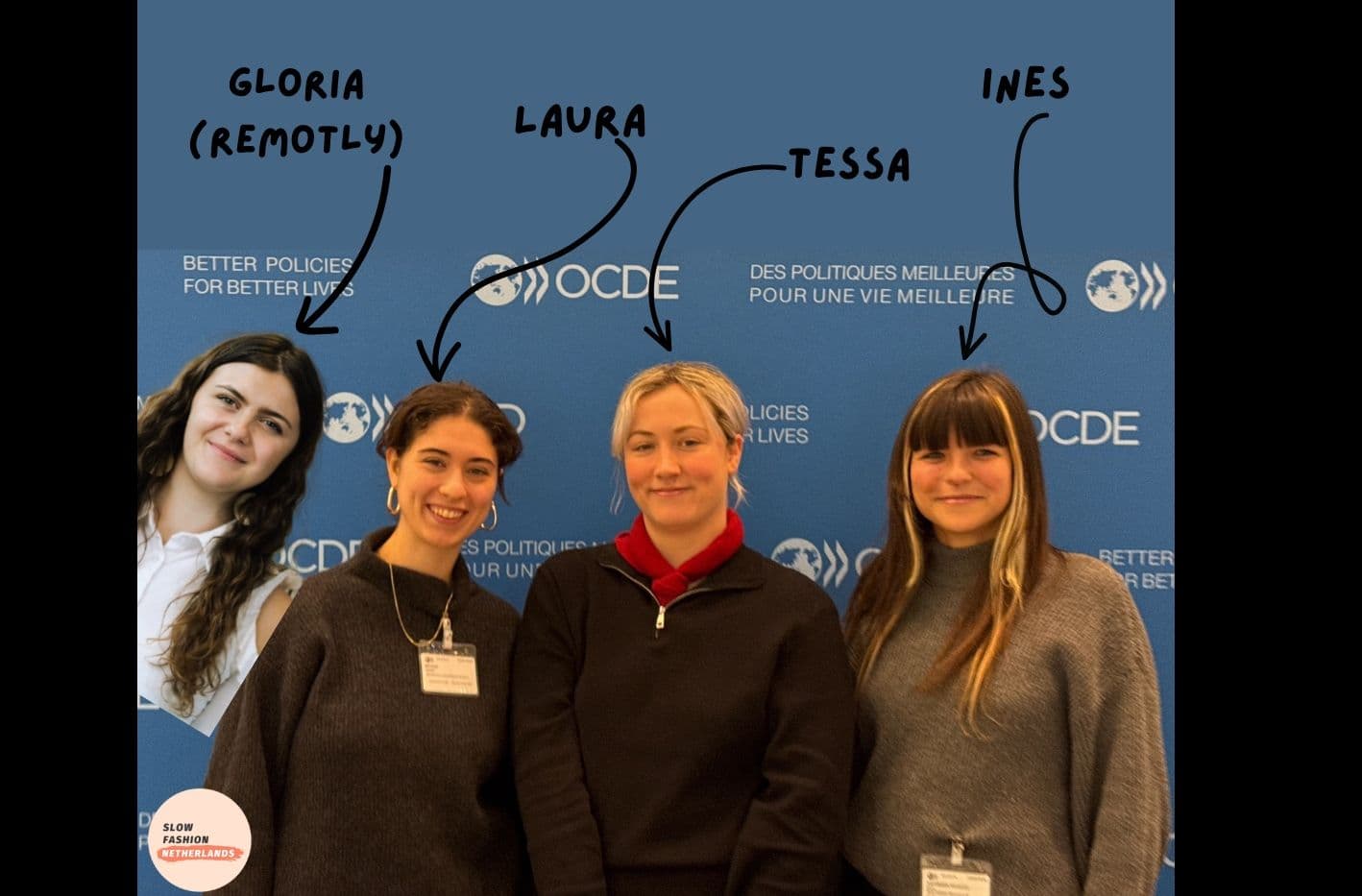
While the February streets of Paris are still grey and rainy, the Slow Fashion Movement Netherlands crew traveled down the OECD Forum on Due Diligence in the Garment and Footwear Sector. A mouth full indeed.
This yearly event connects representatives from government, business, trade unions, civil society, international organisations and academia to discuss challenges as well as learnings and solutions related to implementing due diligence in global garment and footwear supply chains. So, what have we learned?
But first: some explaining
Like many conferences, the OECD Forum is packed with concepts that are not necessarily part of daily vocabularies. As such, it is helpful to break down some concepts before we dive in.
First of all: what is the OECD? OECD stands for Organization for Economic Co-operation and Development. Its 38 member states are mostly nations from the Global North. The organization was once established to help the EU rebuild after WWII, but nowadays it focuses on establishing economic and social development worldwide. At the Forum on Due Diligence in the Garment and Footwear Sector, stakeholders from the garment industry come together to discuss the problems the industry faces and how to move forward.
With that cleared up, let’s move to a second confusing concept: due diligence. Due diligence is the ongoing process companies use to identify, prevent, and address actual and potential negative impacts related to workers, human rights, the environment, and governance throughout their supply chains and business relationships. The OECD has set up due diligence standards that companies and other actors in the fashion industry should follow.
Think of things like: Brands have to know their supply chain- Figure out who's making their clothes, not just the final factory but also fabric suppliers and cotton farms. They have to spot the problems - Look for issues like workers being underpaid, forced to work crazy hours, or working in unsafe buildings that could collapse or catch fire. Fix what's wrong - Work with factories to improve conditions, do inspections, and talk to workers directly. Pay attention to their own role - Make sure they're not causing problems by demanding impossible deadlines or paying prices so low that factories cut corners. Help workers who've been harmed - Set up ways for workers to complain safely and contribute to compensation when things go wrong. Keep checking and be honest - Regularly monitor what's happening and tell the public what they found and what they're doing about it.
First impressions of the Forum
The forum was opened by one of the OECD’s directors Carmine Di Noia, who welcomed us by stating that only 26% of companies currently report on their due diligence. While this might not be a shocking fact to anyone who has some experience in the garment sector, it is still an abhorrently low number that is definitely worth mentioning. Because complying to due diligence standards is one thing, but at stage we should at least have brands that, at the very very least, report on their activities.
Companies have a responsibility to society to conduct business not just in a profitable way, but also in compliance with ethical, sustainable and democratic-based rules. In order for governments and consumers to check these businesses, it is vital that they report on matters of due diligence. This opening statement from Di Noia would prove to be the first of many red flags that were raised throughout the Forum.
The opening panel also revealed other issues that many people tend to overlook in fashion and which reveal the complexity of the system as a whole.
For example, while many of us like to think of Covid as something in the past,** the post-Covid era is now just fully revealing the impact and cost of this shock to the system**. During Covid the biggest news was that brands cancelled orders on a large scale, leading to devastating losses of income for workers (in times where workers were already facing extreme vulnerabilities of livelihood loss and harm to their health). But now, post-covid, the true consequences of the pandemic come to the front. While pre-covid fashion already had extremely short production times, brands now push for even shorter lead times, placing more risks and pressure on suppliers and workers. However, good things have also come from the pandemic, as explained by Christina Hajagos Clausen from IndustriAll. As she explained, countries like South Africa that had a stronger history of social dialogue and that have established binding due diligence agreements, were much less negatively affected by the disruptions of Covid. By changing their purchasing practices, brands can make a huge difference in making their supply chain more resilient in the future.
Another example of the interrelated web of social, economic, and environmental sustainability comes together in the fact, as mentioned by Di Noia, that** garment workers face 22 million heat related injuries per year on a global scale**. As you can imagine, heat stress is common in garment factories, as they are often located in hot climates and usually have poor ventilation or cooling. And, as can be expected, heat related health problems are getting worse due to climate change. While sick workers are bad for business, the key issue is that bad business leads to sick workers. Again, more sustainable purchasing practices are a large factor of positive change.
You might think that at Slow Fashion Movement, it is in the very fabric of our organization that we are particularly critical to highlight brands’ purchasing practices. But in fact, even at the OECD purchasing practices are recognized as one of the main driver of issues in the industry. Overall, most actors at the conference come back to this point - of course with the grand exception of brands themselves.
You wanna be on top?
The post-colonial dynamics of the fashion industry can be observed in interesting ways at the OECD. While its membership and location of the forum obviously affects the selection of attendees - who are mostly white, high-educated and from the Global North - the true influence of the sector’s colonial identity comes to a boil in the panel discussions.
The OECD deserves some praise here: the panels are somewhat diverse and it is clear that efforts have been made to represent several layers - at least until tier 1 - of the fashion value chain. Though improvements can be made to create a more inclusive and accessible format.
Yet the main problem stems from the narrative that dominates the conference rooms - a narrative that protects the status-quo by keeping things ‘diplomatic’ (or ‘gezellig’ as we would say in Dutch). What do we mean by that?
Stakeholders across the value chain are routinely spoken of as if they occupy equivalent positions, a framing that obscures a fundamental reality: brands wield a degree of structural power that suppliers, workers, consumers, and even governments simply do not possess. Maintaining the fiction of parity is not only implausible, but actively misleading - yet it remains a widely rehearsed and largely unquestioned posture within OECD discussions. This imbalance was laid bare when a Disney representative claimed that the company exercises little to no influence on the ground and therefore should not be held accountable under due diligence standards, only to immediately recount how Disney single-handedly persuaded the Egyptian government to enact sweeping labor reforms against the wishes of an authoritarian regime. That is power. Perhaps more striking still is that such a cognitively dissonant narrative could be delivered before a room of experts without provoking any serious challenge, a silence that, in itself, maybe speaks to an even more profound type of ideological power.
Of course, the origins of the OECD explains why we have to remain vigilant of post-colonial tendencies, even if due diligence mechanisms are supposed to ‘mean well’. A good example of this is what happened during a session on ‘responsible disengagement’. You might wonder: what does that mean? Typically, when brands finds problems with their supplier like child labor or sexual abuse, the initial response is to no longer do business with that supplier. However, research shows that this is not solving any problems, but rather pushes such issues even further into the shadows. Instead, brands should work actively and long-term with suppliers to solve these issues. The OECD supports this, and is establishing a conduct for ‘responsible disengagement’, helping brands to decide when and how is a good way to leave a supplier. Basically, the conduct states that only under ‘very severe’ misconducts should a brand withdraw from a factory, like when it is mixed up in war crimes or very severe, systematic sexual abuse.
Fair enough, is what we thought. But at SFM, we just wanted to get one thing cleared up: usually, it isn’t issues with due diligence that make a brand leave a supplier, but most ‘disengagement’ stems from a much more economical issue: when someone else does it cheaper, a brand will not hesitate to switch suppliers. We asked how these OECD principles translate to these ‘flying geese’ business models. Is a ‘competitive price’ considered similarly grave as ‘war crimes’, and thus makes a good reason to leave? Unfortunately, our public question remained awkwardly unanswered, as it was a matter of “discussion for a later time”, “different session”, yada, yada. It shows that, while the effort for due diligence is certainly noble, the OECD is also not void of adhering to capitalist and in turn colonial principles - which ultimately undermine most due diligence efforts (if you want to learn more about how textiles, capitalism, and colonialism are fundamentally intertwined, we advise the work of Sven Beckert: Empire of Cotton). A tricky paradox.
From this emanates another weird dynamic: an atmosphere where brands feel they can either proudly promote harmful purchasing practices or where they place themselves in the dock and openly pity their own position.
A telling moment came during a panel featuring the US fashion brand Reformation. With a confidence that bordered on pride, the brand’s representative described how Reformation was “taking the benefits of the fast fashion model” and steering the company toward a hybrid of fast and ultra-fast fashion. Those benefits, unsurprisingly, translate into faster turnaround times and higher margins - precisely the dynamics most closely associated with environmental degradation and labor exploitation in the industry. Technology was framed as the great enabler of this transition. Yet when SFM asked how the environmental impacts of these technologies are assessed, or whether the growing degree of control they afford over the value chain is meaningfully examined, the response dissolved into abstraction. Stripped of its polish, the answer amounted to a quiet admission that such questions have yet to be taken seriously. What is striking is not only the substance of the position, but the ease with which it was articulated in an OECD setting, as though no tension or accountability were expected to follow.
The conference closed with a moment that was subtler, but no less revealing. In the final session, roughly a hundred participants were asked to group themselves according to their role in the value chain. When it came time to report back, the ‘brand’ group opened by noting - only half-jokingly - that they were, as usual, the last to be heard. This isn’t just inappropriate because it is quite literally the other way around, but because millions of workers in this industry are facing abuse, livelihood risks, and health issues because the voice of brands dominates the value chain. Fatigue after two long days may explain the comment; it does not excuse it. In an industry structured around brand dominance, where value concentrates at the top while garment workers in the Global South absorb the harm, the irony was sharp, too sharp for our taste at least. It was an awkward way to end a long day, but also a strangely fitting one: a small, offhand remark that mirrored the deeper distortions the conference had spent the day circling around without quite confronting.
The role of technology
This wasn’t the first year we attended the Forum, and we were happy to see that the role of ‘industry 4.0’ technology was finally seriously discussed - as it wasn’t the years prior. In his opening speech, Di Noia touched upon the disruptive and positive aspects of tech, and two sessions (“Centering rightsholders in digital supply chain accountability tools” and “Supply chains 4.0: Due Diligence Implications of E-commerce Driven Business Models”) were dedicated to this important issue.
As there is too much to be said about this topic for one article, we will expand on the SFM website. For now, this little teaser of what’s to come will have to do.
Closing remarks
In the end, the OECD Forum left us with plenty of vocabulary, frameworks, and good intentions, but far fewer moments of genuine reckoning. Due diligence was discussed at length, power rarely so; harm was acknowledged, accountability politely deferred. If anything, the conference proved that the problem is no longer a lack of knowledge, but a surplus of comfort with contradiction. Until brands are expected to match their influence with responsibility - and until that expectation is enforced rather than merely debated - forums like this risk becoming well-lit rooms where everyone agrees something is wrong, while carefully avoiding who, exactly, needs to change.